
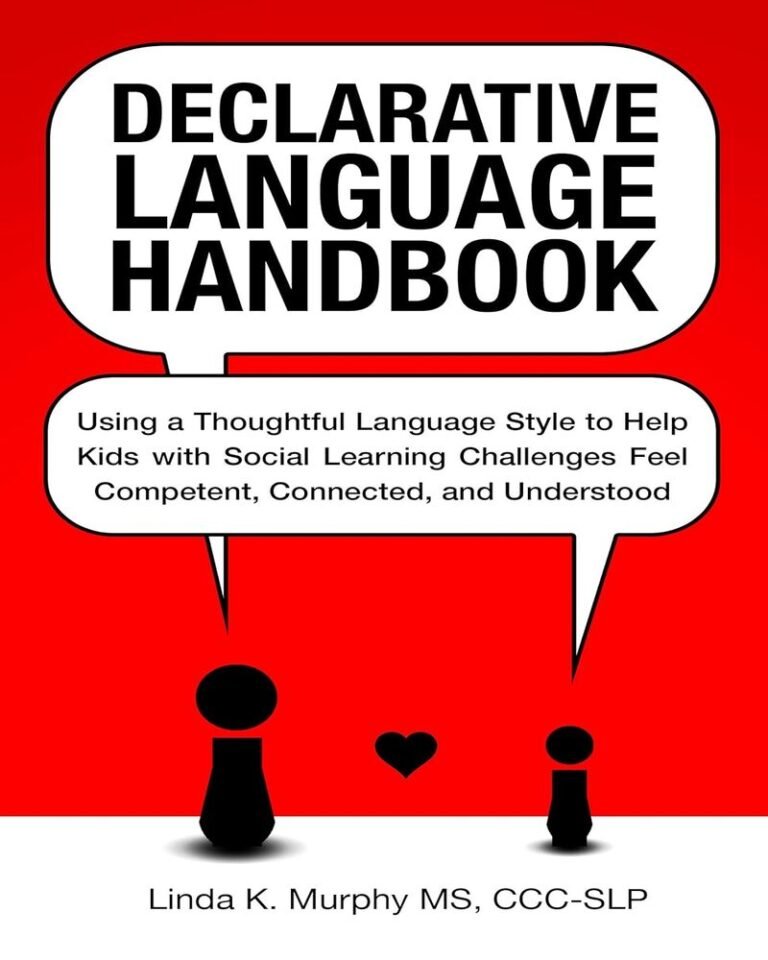







Declarative Language Handbook
A practical guide to making small but meaningful changes in the way
adults speak with children — helping create more opportunities for
thinking, problem solving, flexibility, connection, and discovery.
Social Learning
Problem Solving
Connection
Small Changes in Language Can Create Very Different Opportunities
Children with social learning challenges may have difficulty adapting
when routines change, seeing the bigger picture, solving problems in
the moment, understanding nonverbal information, or navigating relationships.
Declarative Language Handbook
offers adults a different way to communicate: instead of constantly
telling a child what to do, provide thoughtful information that
gives them space to notice, think, connect ideas, and make discoveries.
Linda K. Murphy, MS, CCC-SLP, turns this communication shift into
practical guidance that can be used by parents, teachers, therapists,
caregivers, and other adults supporting children.
Declarative language shifts communication away from a constant stream
of instructions and toward observations, information, shared thinking,
and opportunities for the child to participate in solving the moment.
From Imperative Language to Declarative Language
The goal is not simply to get immediate compliance.
The goal is to create more opportunities for awareness,
thinking, connection, and independent problem solving.
Tells the child what to do
The adult often carries most of the thinking and decision-making in the interaction.
Gives information that invites thinking
The child has more opportunity to notice what is happening,
connect information, and decide what to do next.
Build Skills Through Everyday Communication
Create more opportunities to notice change, consider possibilities,
and respond when situations do not go exactly as expected.
Give children space to use available information and participate
more actively in figuring out what comes next.
Use language in ways that encourage shared attention,
perspective, interaction, and connection.
Everyday opportunities to think and adapt can contribute
to greater confidence when challenges arise.
Shift more of the thinking process toward the child rather than
having adults direct every step.
Simple Communication Shifts You Can Use in Everyday Moments
The handbook focuses on practical examples and clear guidance so
declarative language can be used during ordinary routines,
learning situations, social interactions, and moments of uncertainty.
Help Children Feel More Competent, Connected & Understood
Changing adult communication is not only about teaching skills.
It can also change the tone of interactions by creating more room
for partnership, shared thinking, and recognition of what the child can already do.
One Communication Approach — Many Everyday Settings
Written for adults who want practical ways to communicate more
thoughtfully with children experiencing social learning challenges,
regardless of a specific diagnosis.
The approach may be useful for children with a range of learning
profiles, including autism, ADHD, PDA, social learning differences,
and other situations where communication, flexibility, or
real-time problem solving can be challenging.
Change the Conversation — Not Just the Child’s Behavior
Learn how thoughtful changes in everyday language can create
more opportunities for flexibility, problem solving, resilience,
connection, and independent thinking.




Reviews
There are no reviews yet.