
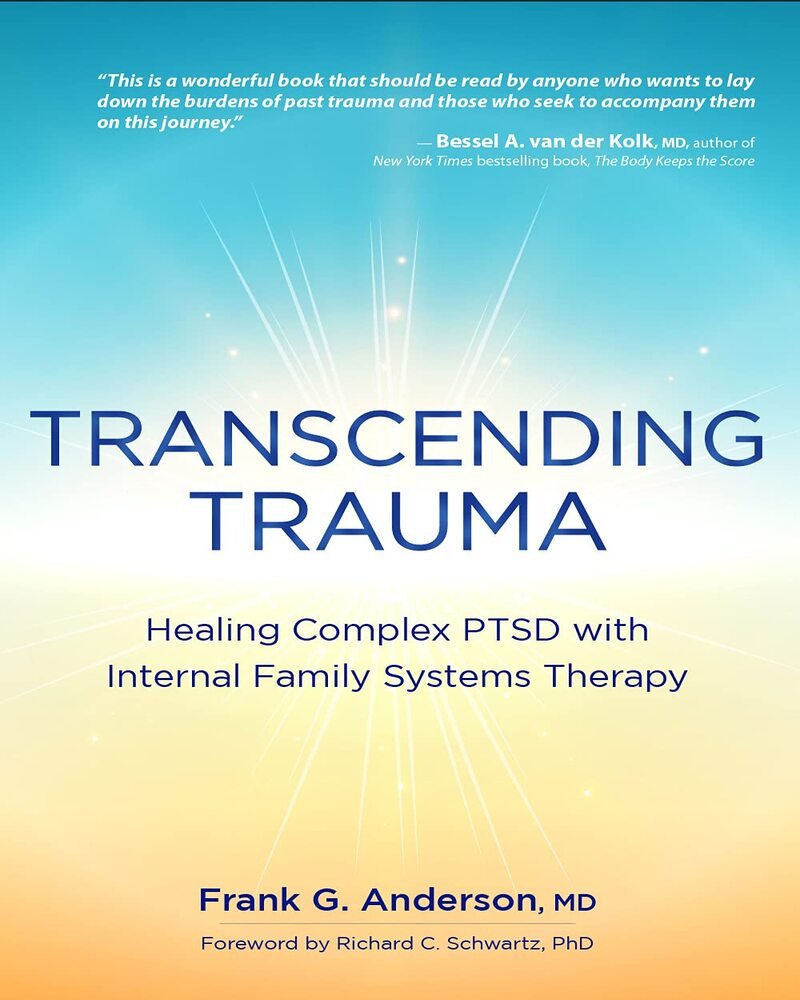



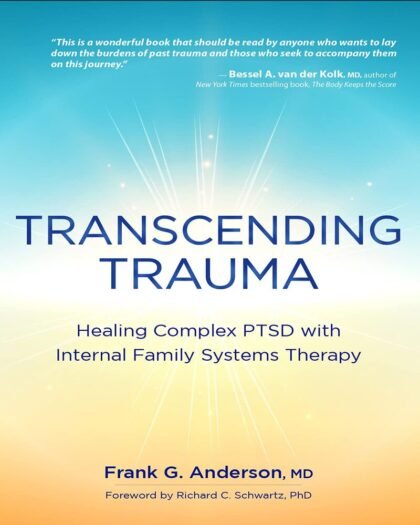
Transcending Trauma
A compassionate and clinically focused guide to working with complex
and dissociative trauma through Internal Family Systems, neuroscience,
attachment work, and the healing capacity of Self-energy.
Complex PTSD
Dissociation
Neuroscience
A Compassionate Map for Working With Complex Trauma
Transcending Trauma
explores an Internal Family Systems approach to complex and
dissociative trauma, with particular attention to the intense
emotions, protective responses, and relational wounds that can
accompany traumatic experience.
Frank G. Anderson, MD, presents a therapeutic path that helps clients
access their inherent capacity for healing —
Self-energy —
while learning to welcome and understand extreme emotional states
rather than simply trying to control or suppress them.
Designed with clinicians in mind, the book combines practical guidance,
clinical cases, neuroscience, personal stories, and treatment
considerations into a comprehensive framework for complex trauma work.
The IFS perspective presented in the book offers a different way of
approaching trauma-related reactions — with curiosity, compassion,
internal connection, and greater access to Self-energy.
Build Greater Confidence With Difficult Trauma Presentations
Develop a steadier clinical stance when intense trauma-related
symptoms and emotional responses emerge.
Explore an IFS-informed approach to relational and attachment wounds
within complex trauma treatment.
Gain a clearer framework for approaching some of the most
challenging features of complex trauma.
Connect trauma treatment with current understanding of the
neurobiology associated with PTSD and dissociation.
Bring neuroscience-informed perspectives into practical,
relationship-centered trauma treatment.
Access the Healing Capacity of Self-Energy
Central to the book is the IFS idea that beneath protective
trauma responses is an inherent capacity for calmness,
compassion, connection, and healing.
Recognize Protective Responses
Understand extreme responses as meaningful adaptations rather than simply symptoms to eliminate.
Approach With Curiosity
Shift from fighting internal experiences toward understanding what they are trying to protect.
Strengthen Self-Connection
Support greater access to internal steadiness, compassion, and connection.
Reconnect With Others
Work toward restoring the capacity for closeness, trust, and meaningful relationships.
Clinical Guidance Supported by Cases, Research & Personal Insight
The book combines several forms of learning to help clinicians
translate complex trauma concepts into practical understanding.
Integrate IFS Into Broader Trauma Treatment
Medications & Comorbidities
Consider medication-related issues and common co-occurring clinical concerns within complex trauma care.
Other Treatment Models
Explore ways to incorporate IFS alongside other therapeutic approaches.
Comprehensive Treatment Planning
Build a broader framework for working with the layered realities of complex and dissociative trauma.
From Disconnection Toward Self-Connection
Across its clinical framework, the book emphasizes helping clients
reconnect with themselves, develop greater self-compassion,
and regain the capacity for connection and love in relationships.
A Valuable Resource for Complex Trauma Clinicians
Designed primarily for clinicians seeking a compassionate,
integrated framework for understanding and treating complex,
relational, and dissociative trauma.
Explore a Compassionate Path Through Complex Trauma
Discover an IFS-informed clinical framework supported by case examples,
neuroscience, attachment work, dissociation guidance, and practical
strategies for complex trauma treatment.


Reviews
There are no reviews yet.